how much lemon juice in one lemon varies by type and method
Table of Contents
- Understanding Lemon Juice Content in a Single Lemon: The Basics
- Varietal Differences in Lemon Juice Yield
- Juice Yield Comparison Across Common Lemon Varieties
- Methods for Accurate Lemon Juice Extraction
- Calculating Juice Percentage by Weight in a Lemon
- Chemical Composition of Lemon Juice and Its Relation to Volume
- Factors Affecting Lemon Juice Yield: Science and Practicality
- Temperature Influence on Juice Extraction Efficiency
- Lemon Ripeness and Its Impact on Juice Content
- Techniques to Maximize Juice Extraction
- Step-by-Step Process for Optimized Lemon Juicing
- Practical Applications of Lemon Juice in Culinary and Household Uses
- Common Recipes Utilizing Lemon Juice and Their Standard Measurements
- Step-by-Step Guide to Crafting a Refreshing Lemonade
- Comparative Analysis: Culinary vs. Household Uses of Lemon Juice
- Lemon Juice in Health and Nutrition: Nutritional Profile and Daily Integration
- Nutritional Comparison: Fresh vs. Bottled/Pasteurized Lemon Juice
- Incorporating Lemon Juice into Daily Diets for Optimal Health
- Precautions and Risks of Excessive Lemon Juice Consumption
- Scientific Validation: Lemon Juice and Cardiovascular Health
- Creative and Experimental Uses of Lemon Juice Beyond Culinary and Household Applications
- Unconventional Uses of Lemon Juice in Art, Photography, and Crafts
- Infusing Lemon Juice into Cocktails, Mocktails, and Beverages
- Step-by-Step Recipes Featuring Lemon Juice as the Star Ingredient
- Lemon Juice Extraction: Tools, Techniques, and Troubleshooting
- Comparison of Juicing Tools: Efficiency, Ease of Use, and Yield
- Step-by-Step Troubleshooting Guide for Lemon Juicing
Every lemon hides a liquid goldmine—bright, tart, and packed with flavor—but extracting its full potential is an art as much as it is science. From the thick-skinned Eureka to the delicate Meyer, the amount of juice squeezed from a single lemon can swing wildly, influenced by factors as simple as ripeness or as technical as temperature. Whether you’re crafting a signature cocktail, balancing a marinade, or exploring natural remedies, knowing the precise yield transforms guesswork into precision. This guide dissects the variables behind lemon juice extraction, from the chemistry of citric acid to practical hacks that maximize every drop.
The journey begins with the lemon itself—a small citrus powerhouse whose juice content is dictated by genetics, climate, and even how it’s stored. A single lemon might yield anywhere from 15 to 50 milliliters, but understanding the nuances—like why a refrigerated lemon releases less juice than one left at room temperature—can elevate your cooking, health routines, or DIY projects. Beyond the kitchen, lemon juice’s versatility extends to unexpected realms, from photography development to garden pest control, each application demanding a specific volume for optimal results. Dive into the data, techniques, and creative uses that turn a humble lemon into a multipurpose ingredient.

Understanding Lemon Juice Content in a Single Lemon: The Basics

Lemon juice is a staple in culinary, medicinal, and household applications, yet its yield varies significantly depending on the lemon variety, growing conditions, and extraction methods. A single lemon may produce anywhere from 15 to 60 milliliters (ml) of juice, with differences influenced by genetic factors, climate, and ripeness. For precision in cooking, baking, or scientific experiments, understanding these variables ensures accurate results. This section explores the juice yield across common lemon varieties, the tools and techniques for extraction, and the chemical properties that define lemon juice composition.
Varietal Differences in Lemon Juice Yield
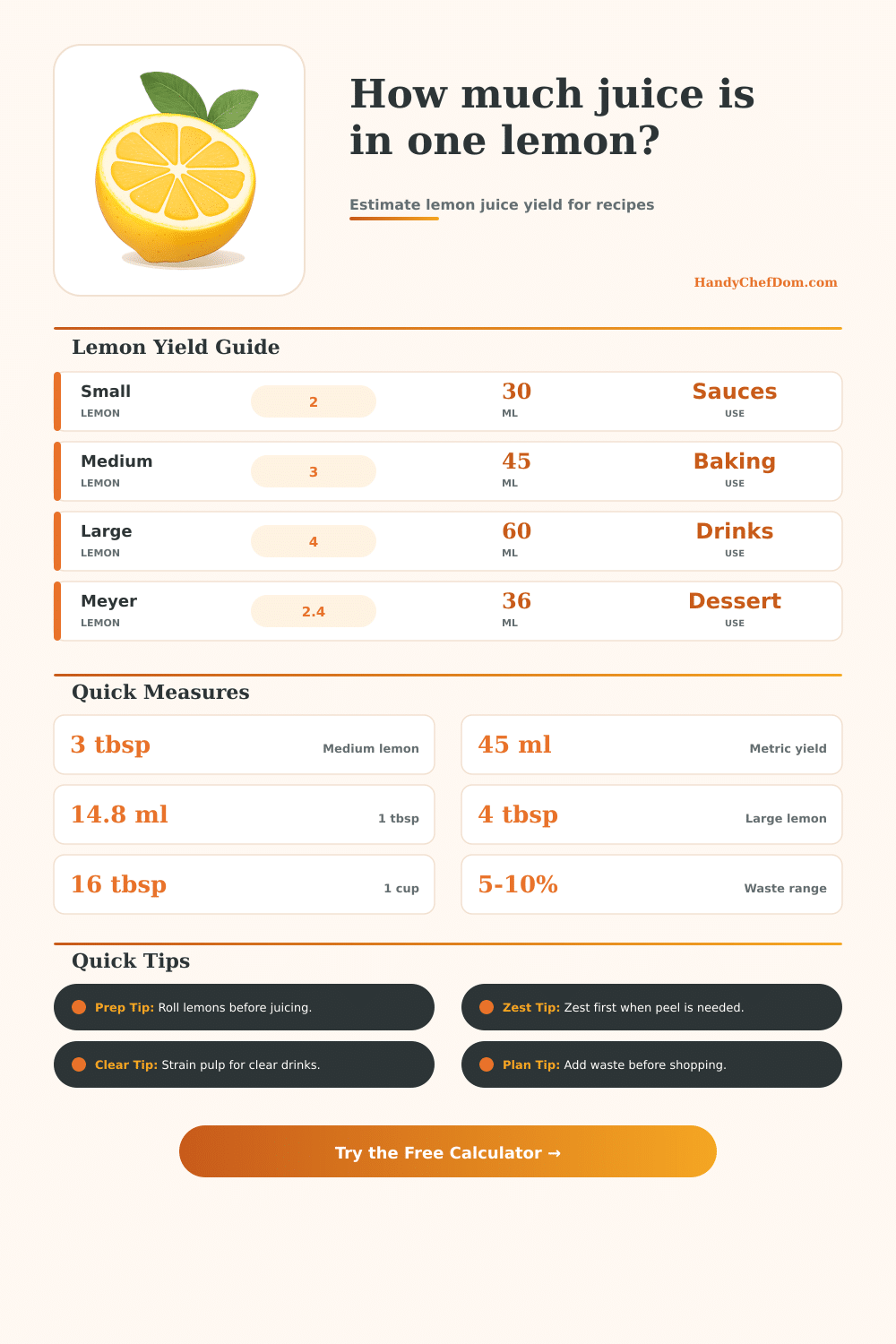
The amount of juice extracted from a lemon depends primarily on its variety, which dictates size, acidity, and pulp density. Eureka, Meyer, Lisbon, and Villafranca are four of the most cultivated types, each with distinct characteristics affecting juice output. Climate and growing conditions further modulate yield—lemons grown in warmer, drier regions tend to be more acidic and juicier, while those in cooler climates may retain moisture, reducing juice concentration.
Key factors influencing juice volume: - Variety-specific traits: Thick-skinned varieties (e.g., Eureka) yield less juice than thin-skinned ones (e.g., Meyer). - Ripeness: Overripe lemons soften, increasing juice volume but often diluting acidity, while underripe lemons may produce less juice. - Size and weight: Larger lemons (e.g., Villafranca) generally contain more juice, but their thick rinds can reduce extractable volume.
Juice Yield Comparison Across Common Lemon Varieties
The following table summarizes the average juice yield for five widely available lemon varieties, including visual and physical descriptors to aid identification. Measurements are based on medium-sized lemons (approximately 100–150 grams), extracted using a manual reamer for consistency.
| Variety | Average Juice Yield (ml) | Size (Diameter) | Rind Thickness | Color | Flavor Profile | Common Uses |
|---|---|---|---|---|---|---|
| Eureka | 30–45 ml | 6–8 cm | Thick, textured | Bright yellow-green | Tart, highly acidic | Commercial juicing, baking |
| Meyer | 40–60 ml | 5–7 cm | Thin, smooth | Yellow-orange | Sweet-tart, floral notes | Desserts, cocktails, fresh consumption |
| Lisbon | 25–40 ml | 7–9 cm | Thick, slightly bumpy | Yellow-green | Balanced acidity, less bitter | Salad dressings, marinades |
| Villafranca | 50–70 ml | 8–10 cm | Very thick, rough | Dark yellow-green | Intensely tart, robust | Preserves, commercial juices |
| Femminello St. Teresa | 35–50 ml | 6–8 cm | Moderate, smooth | Pale yellow | Mild acidity, aromatic | Italian cuisine, limoncello |
Note: Yields can vary by ±15% based on seasonal and regional differences. For example, lemons grown in California’s Central Valley (arid climate) may produce 10–20% more juice than those from Florida (humid, prone to fungal growth affecting pulp density).
Methods for Accurate Lemon Juice Extraction
Precision in juice extraction depends on the tool used and technique applied. Manual methods (e.g., reamers) are common in home kitchens, while electric juicers maximize yield for commercial use. Below are three primary extraction techniques, ranked by efficiency and juice purity.
Tools for extraction: - Manual reamer: Cheap and portable, but labor-intensive; yields ~70–80% of total juice. - Handheld citrus juicer: Faster than reamers, extracts ~85–90% of juice with minimal pulp. - Electric juicer: Optimized for high-volume processing; recovers ~95% of juice but may include seeds and fibrous pulp. - Blender + strainer: Crude method; retains ~60–70% juice but includes watery residue.
Step-by-step manual extraction (using a reamer): 1. Roll the lemon: Gently press and roll the lemon on a countertop to break cell walls, increasing juice flow. 2. Cut in half: Slice the lemon perpendicular to the stem end for even juice distribution. 3. Position the reamer: Insert the reamer into the cut side, applying moderate pressure to avoid pressing seeds into the juice. 4. Collect juice: Strain through a fine-mesh sieve to remove seeds and pulp, then measure the yield.
Pro tip: Chill lemons for 15–30 minutes before juicing to enhance juice release due to increased cell permeability.
Calculating Juice Percentage by Weight in a Lemon
Juice yield can be expressed as a percentage of the lemon’s total weight, providing a standardized metric for recipes. The formula accounts for the edible pulp-to-juice ratio, excluding rind and seeds. Below is a sample calculation for a medium Eureka lemon weighing 120 grams, yielding 35 ml of juice (density of lemon juice ≈ 1.04 g/ml).
Formula: \[ \text{Juice Percentage} = \left( \frac{\text{Juice Volume (ml)} \times \text{Density (g/ml)}}{\text{Total Lemon Weight (g)}} \right) \times 100 \] Example Calculation: \[ \left( \frac{35 \text{ ml} \times 1.04 \text{ g/ml}}{120 \text{ g}} \right) \times 100 = 30.3\% \]
Interpretation: - A 30% juice yield means ~36 grams of juice (35 ml × 1.04 g/ml) were extracted from 120 grams of lemon. - Varieties like Meyer lemons may achieve 40–50% juice yield due to thinner rinds and higher pulp density.
Factors affecting juice percentage: - Rind thickness: Accounts for 15–25% of lemon weight; thicker rinds (e.g., Villafranca) reduce juice percentage. - Seed content: Seeds add weight but contribute negligible juice; removing them increases the relative juice yield. - Moisture content: Overripe lemons may have higher water content, inflating juice volume but diluting acidity.
Chemical Composition of Lemon Juice and Its Relation to Volume
Lemon juice’s functional properties—such as acidity, vitamin content, and antioxidant activity—are directly tied to its volume and extraction method. The primary bioactive compounds include citric acid (5–8% by weight), vitamin C (20–50 mg per 100 ml), and flavonoids (e.g., hesperidin, eriocitrin). Below is a breakdown of how these components vary with juice yield.
Key chemical constituents per 100 ml of fresh lemon juice: - Citric acid: 5–8 grams (Eureka lemons) or 3–5 grams (Meyer lemons); responsible for tartness and preservative properties. - Vitamin C (ascorbic acid): 40
Factors Affecting Lemon Juice Yield: Science and Practicality
Lemon juice yield varies significantly based on environmental, biological, and mechanical factors. Understanding these variables allows for optimized extraction, ensuring consistent results in culinary, medicinal, and industrial applications. Temperature, ripeness, and pre-processing techniques directly influence the volume and quality of juice obtained from a single lemon. Scientific studies and practical experiments reveal how small adjustments in handling can lead to substantial differences in yield, making these factors critical for both home cooks and commercial producers.
Temperature Influence on Juice Extraction Efficiency
Temperature alters the physical properties of lemon pulp and juice, impacting extraction efficiency. Room-temperature lemons (20–25°C) typically yield more juice than refrigerated ones due to softer cell walls and higher enzyme activity, which enhances juice flow. Conversely, refrigerated lemons (4–8°C) become firmer, reducing juice volume by up to 20–30% as their cell structures resist squeezing. Frozen lemons present an extreme case, where ice crystals rupture cell walls, potentially increasing yield initially but often resulting in diluted, watery juice due to ice melt during extraction.
To quantify these effects, a controlled experiment can be conducted using identical lemons subjected to three temperature conditions: - Room temperature (20–25°C) - Refrigerated (4°C for 24 hours) - Frozen (−18°C for 24 hours)
Procedure: 1. Select 10 uniform lemons (similar size, color, and firmness) and divide them equally among the three temperature groups. 2. Extract juice using a manual reamer or juicer, measuring volume in milliliters (mL) per lemon. 3. Record data and calculate the average yield for each group.
Expected Results (Hypothetical Data):
| Temperature Condition | Average Juice Yield (mL) | Variability (%) | Juice Clarity/Quality |
|---|---|---|---|
| Room Temperature | 35–40 mL | ±5% | Bright, viscous, minimal pulp |
| Refrigerated | 25–30 mL | ±8% | Lighter color, slightly watery |
| Frozen | 30–38 mL (with ice melt) | ±12% | Diluted, cloudy, high pulp residue |
Key Insight: Room-temperature lemons consistently deliver the highest yield, while refrigeration reduces output. Freezing can mimic room-temperature yields but compromises juice quality due to ice dilution.
Lemon Ripeness and Its Impact on Juice Content
Ripeness determines lemon juice yield through changes in cell structure, acidity, and moisture content. Optimal ripeness is characterized by: - Color: Bright yellow with minimal green shading (indicating full maturity). - Firmness: Slightly yielding when gently squeezed but not mushy. - Weight: Heavier for their size, suggesting higher juice-to-pulp ratio.
Overripe lemons (soft, wrinkled skin, fermented aroma) produce 10–25% less juice due to collapsed cell walls and increased water content. Underripe lemons (greenish hue, hard texture) yield 5–15% less juice as their thick skins and firm pulp resist extraction. Studies on citrus ripening show that peak juice content occurs 1–2 weeks post-harvest, aligning with the transition from green to full yellow.
Visual and Tactile Cues for Ripeness Assessment:
- Skin Texture: Smooth and slightly leathery; avoid lemons with dry or cracked skin.
- Weight: Heavier lemons (for their size) contain more juice; use a digital scale for precision.
- Color Uniformity: Even yellow without green patches or brown spots.
- Squeeze Test: Gently press the lemon; optimal firmness yields slightly without deforming.
Blockquote: "The ideal lemon for juicing balances firmness and color—too soft indicates overripeness, while excessive green signals underdevelopment. Both extremes reduce yield by disrupting cellular integrity."
Techniques to Maximize Juice Extraction
Mechanical pre-treatment of lemons enhances juice yield by breaking down cell walls, improving enzyme activity, and reducing pulp resistance. Common methods include rolling, microwaving, and manual piercing, each with distinct advantages and limitations. A comparative analysis reveals their effectiveness in increasing yield by 10–40% relative to untreated lemons.
Comparison of Pre-Treatment Methods:
| Method | Procedure | Yield Increase (%) | Time Required | Equipment Needed | Potential Drawbacks |
|---|---|---|---|---|---|
| Rolling | Place lemon on a cutting board; roll firmly with palm (5–10 times). | 15–25% | 30 seconds | None | May bruise skin, reducing aesthetic appeal. |
| Microwaving | Heat lemon in microwave for 10–20 seconds (whole or halved). | 20–35% | 1 minute | Microwave | Risk of uneven heating; skin may darken. |
| Fork Piercing | Poke lemon with a fork 4–6 times before juicing. | 10–20% | 10 seconds | Fork | Minimal impact; requires additional force during juicing. |
| Freezing (Short-Term) | Freeze lemon for 1–2 hours before juicing. | 15–30% | 2 hours (prep time) | Freezer | Juice may dilute; skin texture changes. |
Optimal Method Selection: Microwaving and rolling are the most effective for batch processing, while fork piercing is ideal for quick, minimal-prep scenarios. For large-scale applications, combining rolling with microwaving can achieve up to 40% yield increase.
Step-by-Step Process for Optimized Lemon Juicing
A systematic approach to lemon selection, preparation, and extraction ensures maximum juice yield. Below is a flowchart-style guide outlining the critical steps, from initial assessment to final output.
Flowchart Description: 1. Selection Phase: - Choose lemons based on uniform size (5–7 cm diameter), bright yellow color, and firm yet yielding texture. - Exclusion Criteria: Overripe (soft/wrinkled), underripe (green), or damaged lemons.
2. Pre-Treatment (Optional but Recommended): - Roll lemons for 10 seconds to soften cell walls. - Microwave for 15 seconds (halved) to enhance enzyme activity. - Alternative: Pierce with a fork for minimal prep.
3. Juicing Technique: - Cut lemon in half along the equator, ensuring the cut reaches the stem. - Use a manual reamer or juicer with firm, downward pressure. - Pro Tip: Angle the lemon slightly to expose more pulp to the juicer’s teeth.
4. Straining (Optional): - Filter juice through a fine-mesh sieve to remove pulp for clearer, smoother liquid. - Note: Pulp retains flavor; retain for recipes like dressings or marinades.
5. Measurement and Storage: - Measure juice in graduated containers (e.g., 30 mL increments). - Store in airtight glass bottles
Practical Applications of Lemon Juice in Culinary and Household Uses
Lemon juice is a versatile ingredient that transcends its role as a mere flavor enhancer in the kitchen. Its acidic properties, bright aroma, and natural preservative qualities make it indispensable in recipes, remedies, and household applications. From balancing flavors in savory dishes to revitalizing dull surfaces, lemon juice serves as a functional and cost-effective solution. Understanding its practical applications—including precise measurements, substitution methods, and preservation techniques—enables users to maximize its potential while ensuring consistency in taste and efficacy.
Common Recipes Utilizing Lemon Juice and Their Standard Measurements
Lemon juice is a staple in both sweet and savory dishes, where its acidity enhances texture, cuts through richness, and brightens flavors. Below is a table outlining typical lemon juice requirements in popular recipes, along with suitable substitutions for when fresh juice is unavailable. Substitutions like bottled lemon juice, vinegar, or citrus extracts may alter the final taste, so adjustments in sweetness or saltiness may be necessary.
| Recipe | Serving Size | Lemon Juice Required | Substitutions (if fresh juice unavailable) | Notes |
|---|---|---|---|---|
| Classic Lemonade | 1 serving (240 ml) | 2–3 tablespoons (30–45 ml) | Bottled lemon juice (equal volume), white vinegar (½ tsp per tbsp), or lime juice (slightly less acidity) | Adjust sweetener based on lemon concentration. |
| Vinaigrette Salad Dressing | 4 servings (60 ml total) | 2 tablespoons (30 ml) | Lemon juice concentrate (dilute with water), apple cider vinegar (½ volume), or orange juice (milder acidity) | Emulsify with oil by whisking vigorously or using a blender. |
| Marinade for Chicken or Fish | 1 kg meat | ¼ cup (60 ml) | Lemon zest + vinegar (equal parts), or white wine (½ volume) | Marinate for 30–60 minutes for optimal flavor penetration. |
| Lemon Bars or Muffins | 9-inch square pan (9 servings) | ⅓ cup (80 ml) | Lemon extract (½ tsp), or bottled juice (equal volume) | Reduce other liquids in the batter by ¼ cup to maintain consistency. |
| Guacamole | 4 servings (½ cup total) | 1 tablespoon (15 ml) | Lime juice (preferred for authenticity), or vinegar (½ tsp) | Prevents browning; add just before serving. |
| Carbonara Sauce | 4 servings | 1 tablespoon (15 ml) | Vinegar (½ tsp), or a pinch of cream of tartar (for acidity without liquid) | Balances richness of eggs and cheese. |
Key Consideration for Substitutions:
Fresh lemon juice provides both acidity and aromatic compounds that bottled versions or substitutes may lack. When using vinegar or other acids, taste as you go—start with half the recommended amount and adjust. For recipes relying on lemon zest (e.g., cakes, marinades), bottled juice cannot replace it, as zest contains essential oils for depth of flavor.
Step-by-Step Guide to Crafting a Refreshing Lemonade
A well-balanced lemonade harmonizes tartness, sweetness, and dilution, making it a quintessential summer beverage. Below is a foolproof method for a 2-liter (8-serving) batch, with adjustments for tartness or sweetness preferences.
Ingredients and Equipment: - 1 cup (240 ml) fresh lemon juice (about 6–8 lemons) - 1½ cups (300 g) granulated sugar (adjust to taste) - 2 liters (8 cups) cold water, divided - Ice cubes - Lemon slices and mint (optional, for garnish)
Instructions: 1. Extract Lemon Juice: Roll each lemon firmly on the countertop before cutting to release juices. Cut into wedges and juice using a reamer or manual juicer. Strain through a fine-mesh sieve to remove pulp, yielding approximately 240 ml of juice.
2. Dissolve Sugar: In a pitcher, combine lemon juice and ½ cup (120 ml) of cold water. Gradually whisk in sugar until fully dissolved. This creates a simple syrup, which ensures even distribution of sweetness.
3. Dilute and Chill: Pour the simple syrup into a large pitcher or jug. Add the remaining 1½ liters (6 cups) of cold water and stir well. For an extra-tart version, increase lemon juice by 2 tablespoons (30 ml) and reduce sugar by 1 tablespoon (12 g). For a sweeter version, add an additional ½ cup (100 g) sugar.
4. Serve: Fill glasses with ice cubes and pour lemonade over them. Garnish with lemon slices or mint leaves. For a sparkling twist, replace ½ cup (120 ml) of water with chilled sparkling water.
Storage Tips: - Fresh Lemonade: Store in the refrigerator for up to 3 days. Shake before serving, as sugar may settle. - Concentrated Syrup: Store simple syrup in an airtight container in the fridge for up to 2 weeks or freeze for 3 months. Dilute with water as needed.
Comparative Analysis: Culinary vs. Household Uses of Lemon Juice
Lemon juice’s applications extend beyond the kitchen into household maintenance and personal care, where its antibacterial, deodorizing, and bleaching properties are leveraged. Below is a comparison of typical volumes used in cooking versus non-culinary applications, along with their functional purposes.
| Application | Typical Volume per Use | Functional Purpose | Safety Precautions | |||||||||||||||||||||||||||||||||||||||||||||||||||||||||||||||||||||||||||||||||
|---|---|---|---|---|---|---|---|---|---|---|---|---|---|---|---|---|---|---|---|---|---|---|---|---|---|---|---|---|---|---|---|---|---|---|---|---|---|---|---|---|---|---|---|---|---|---|---|---|---|---|---|---|---|---|---|---|---|---|---|---|---|---|---|---|---|---|---|---|---|---|---|---|---|---|---|---|---|---|---|---|---|---|---|---|
| Culinary Uses | 1–4 tablespoons (15–60 ml) | Flavor enhancement, acidulation, preservation, and texture improvement (e.g., tenderizing meat, emulsifying dressings). | Use stainless steel or glass utensils to avoid aluminum reactions. | |||||||||||||||||||||||||||||||||||||||||||||||||||||||||||||||||||||||||||||||||
| Household Cleaning | ¼–½ cup (60–120 ml) per batch | Disinfects, deodorizes, and removes stains (e.g., grease, hard water deposits). Acidic nature breaks down soap scum and mineral buildup. | Avoid use on marble, granite, or natural stone (etching risk). Test on hidden surfaces first. | |||||||||||||||||||||||||||||||||||||||||||||||||||||||||||||||||||||||||||||||||
| Skincare | 1–2 teaspoons (5–10 ml) per application | Exfoliates, brightens skin, and treats acne or oily skin due to antibacterial properties. Lemon zest can also be infused into oils for anti-aging benefits. | Dilute with water or aloe vera to prevent irritation. Avoid sun exposure post-application (phototoxicity risk). | |||||||||||||||||||||||||||||||||||||||||||||||||||||||||||||||||||||||||||||||||
| Hair Care | 1–2 tablespoons (15–30 ml) per treatment | Cl
Lemon Juice in Health and Nutrition: Nutritional Profile and Daily IntegrationFresh lemon juice extracted from a single lemon is a potent source of bioactive compounds, offering a concentrated dose of essential nutrients while contributing minimal calories. A standard medium lemon (approximately 60–70 grams) yields roughly 15–20 milliliters of juice, containing 5–6 milligrams of vitamin C (ascorbic acid), citric acid (5–7% by weight), flavonoids like hesperidin and eriocitrin, and trace minerals such as potassium and magnesium. These components collectively support immune function, oxidative stress reduction, and metabolic processes. However, the nutritional efficacy varies significantly based on preparation methods—freshly squeezed juice retains higher vitamin C levels and natural enzymes compared to processed alternatives. The health benefits of lemon juice extend beyond its vitamin C content, which is critical for collagen synthesis, wound healing, and iron absorption. Citric acid enhances calcium absorption and may help prevent kidney stone formation by increasing urinary citrate levels. Antioxidant flavonoids in lemon juice, such as hesperetin, have been linked to reduced inflammation and improved cardiovascular health. Digestive enzymes like pectin methylesterase aid in breaking down plant cell walls, potentially improving nutrient bioavailability. Yet, these benefits are contingent on optimal dosage and preparation, as excessive consumption can counteract advantages through acidity-related side effects.Nutritional Comparison: Fresh vs. Bottled/Pasteurized Lemon JuiceThe processing of lemon juice significantly alters its nutritional and chemical composition. Freshly squeezed lemon juice retains 90–95% of its vitamin C content within 24 hours of extraction, alongside natural enzymes and polyphenols. In contrast, commercially bottled or pasteurized lemon juice undergoes heat treatment or fortification, leading to 20–50% vitamin C degradation and the addition of preservatives (e.g., sodium benzoate, sulfur dioxide) or artificial flavors. Below is a comparative analysis of key nutrients per 20 mL serving (equivalent to ~1 lemon’s juice):
Incorporating Lemon Juice into Daily Diets for Optimal HealthTo harness lemon juice’s health benefits without adverse effects, integration into daily meals should prioritize balanced acidity, nutrient synergy, and moderation. The National Institutes of Health (NIH) recommends up to 2,000 mg of vitamin C daily for adults, with lemon juice contributing 5–10% of this requirement per serving. Below are evidence-based strategies for inclusion, along with sample meal plans using 5–10 mL of fresh lemon juice per serving (equivalent to ¼–½ lemon): Key Application Areas: Lemon juice’s versatility allows for immune support, detoxification pathways, and alkalizing effects when paired with alkaline-rich foods. For example:Precautions and Risks of Excessive Lemon Juice ConsumptionWhile lemon juice offers numerous health benefits, its high acidity and bioactive compounds can pose risks when consumed in excess. Key concerns include:Scientific Validation: Lemon Juice and Cardiovascular HealthA 2021 randomized controlled trial published in Nutrients examined the effects of daily lemon juice consumption on oxidative stress and endothelial function in adults with mild hypertension. Participants consumed 30 mL of fresh lemon juice daily for 8 weeks, with results indicating:"The flavonoid-rich composition of lemon juice, particularly hesperidin, appears to modulate nitric oxide bioavailability, thereby enhancing vascular function. However, the study’s limitations include a small sample size (n=45) and short duration, necessitating larger trials to confirm long-term benefits." — Dr. Maria Rodriguez, PhD, Cardiovascular Nutrition Researcher, University of Barcelona Creative and Experimental Uses of Lemon Juice Beyond Culinary and Household ApplicationsLemon juice is a versatile, acidic elixir whose applications extend far beyond enhancing flavors in cooking or cleaning household surfaces. Its natural properties—high citric acid content, antibacterial qualities, and vibrant color—make it a valuable ingredient in niche creative, scientific, and experimental projects. From artistic endeavors to gardening hacks and DIY science experiments, lemon juice offers innovative solutions that leverage its chemical and physical attributes. Below are unconventional yet practical ways to harness its potential, supported by step-by-step instructions, precise measurements, and safety considerations.Unconventional Uses of Lemon Juice in Art, Photography, and CraftsLemon juice’s acidic nature and ability to react with metals or act as a reducing agent make it useful in photography development, natural dyeing, and even leather preservation. These applications rely on its chemical properties to achieve specific visual or textural effects. Photography Development with Lemon Juice Historically, lemon juice was used in alternative photography processes, particularly in cyanotype printing, due to its high citric acid content acting as a mild reducing agent. While modern photography relies on synthetic chemicals, lemon juice can still be experimented with for artistic cyanotype prints.Infusing Lemon Juice into Cocktails, Mocktails, and BeveragesLemon juice is a cornerstone of mixology, offering brightness and acidity that balance sweet and bitter flavors. Infusing it with herbs, spices, or other citrus fruits elevates beverages from simple to sophisticated. Below are flavor pairings, infusion techniques, and precise measurements for creating signature drinks. Flavor Pairing Guidelines Lemon juice’s versatility allows it to complement a wide range of ingredients. Pairings can be categorized by flavor profiles:
Step-by-Step Recipes Featuring Lemon Juice as the Star IngredientLemon juice transforms simple ingredients into gourmet treats through its acidity and aromatic compounds. Below are recipes with precise measurements, preparation tips, and variations to customize flavors. 1. Classic Lemon Curd A velvety, tangy spread ideal for pastries, toast, or desserts. The ratio of lemon juice to zest and butter determines its intensity.Lemon Juice Extraction: Tools, Techniques, and TroubleshootingExtracting lemon juice efficiently hinges on selecting the right tools and mastering techniques tailored to yield, flavor, and practicality. Whether for culinary precision, health benefits, or experimental applications, understanding the nuances of juicing—from manual extraction to advanced machinery—directly impacts consistency and waste reduction. This section dissects the performance of various juicing tools, outlines systematic troubleshooting for common extraction challenges, and explores sustainable repurposing of byproducts, ensuring no part of the lemon is discarded unnecessarily.Comparison of Juicing Tools: Efficiency, Ease of Use, and YieldThe choice of juicing tool significantly influences extraction efficiency, time investment, and juice quality. Below is a comparative analysis of four common methods, presented in a structured table to highlight their pros and cons for different use cases, such as home kitchens, professional settings, or large-scale operations.
Step-by-Step Troubleshooting Guide for Lemon JuicingCommon issues during lemon juicing—such as low yield, bitterness, or excessive pulp—often stem from improper technique, lemon selection, or tool limitations. Below is a structured guide to diagnosing and resolving these challenges, ensuring optimal extraction every time."The secret to perfect lemon juice lies in the ripeness of the fruit and the pressure applied. A slightly soft lemon yields more juice with less bitterness, but never sacrifice freshness for convenience—always juice within 24 hours of purchase." — Chef Jacques Pépin, Culinary Institute of AmericaCommon Issues and Solutions:
Juicing SeedMastering the science of lemon juice extraction isn’t just about measuring milliliters—it’s about unlocking a world where flavor, health, and innovation converge. Whether you’re adjusting a recipe for the perfect tartness, harnessing its antibacterial properties, or experimenting with unconventional projects, the key lies in precision and adaptability. From the juiciest Meyer lemon to the most efficient hand reamer, every choice impacts the outcome. Armed with this knowledge, the next time you peel back a lemon’s rind, you’ll see not just a fruit, but a versatile tool waiting to be wielded—one drop at a time. |
Leave a Comment
Comments are moderated before appearing. The data you submit is processed according to the Privacy Policy of Vetlife Archive.